Market News
From rally to rout in 24 hours: what the midterm flip taught investors
The Dow's best day since April 2025 was followed by a tech sell-off that pushed the Nasdaq toward correction, on the same news. What changed, and what to watch next.
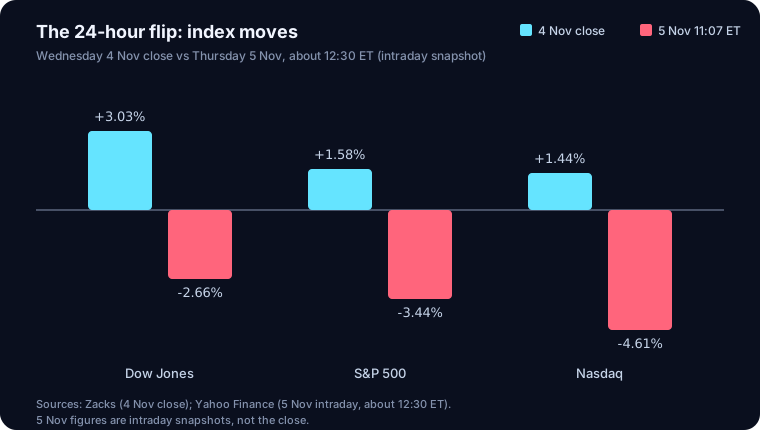
On Wednesday 4 November, the Dow Jones Industrial Average jumped 1,569.40 points, or 3.03%, to 53,356.12, its best day since April 2025. The S&P 500 rose 1.58% to 7,688.62 and the Nasdaq Composite gained 1.44% to 25,736.51.
By Thursday, the mood had flipped. As of about 12:30 ET, the Nasdaq was down 4.6% on the day at 24,549.56, the S&P 500 was down 3.4% at 7,424.46 and the Dow was down 2.7% at 51,938.19. The sell-off had eased a little from the morning lows — at 11:07 ET the Nasdaq had been down 5.24% — but the direction was the same. The same event moved the market in opposite directions within 24 hours. That is the story worth understanding.
Figures for Thursday 5 November are intraday snapshots, captured in New York between late morning and early afternoon: index levels as of about 12:30 ET, individual stocks as of about 13:40 ET. The session had not closed when this was written.
Wednesday: relief, and cheaper oil
The trigger was the US midterm election on 3 November. Democrats won control of both the House and the Senate, and on Wednesday investors read that as gridlock: less political uncertainty, and less chance of sudden policy change. The fear gauge told the same story. The VIX fell 20.3% to 16.61.
The rally was broad, not narrow. Twenty-seven of the 30 Dow stocks rose, and 9 of the 11 S&P 500 sectors finished green. Consumer Discretionary rose 4.3%, Financials 3.5% and Real Estate 3.2%. Microsoft rose 6.7% and Amazon 6.1%.
Oil gave the rally a second push. WTI crude fell 8.3% to $88.12 a barrel and Brent fell 8.7% to $94.62, their lowest settlements since 31 August, as traders bet a Democratic Congress made renewed US strikes on Iran less likely. Gold moved the other way, rising 3.4% to $4,074.50.
Thursday: the same result, read differently
Thursday, traders repriced the same election result. A Democratic Congress also means closer scrutiny of the AI data-centre buildout, and that hit the trade that had carried the market all year.
Chip stocks led the fall. The PHLX Semiconductor Index fell nearly 11% at its lows, its worst day since March 2020, and about 35% below its 52-week high close of 14,634.72, set on 22 June. Nvidia fell more than 8% and Micron more than 15%. The Nasdaq fell more than 10% below its record closing high of 27,599.89, set on 6 October, putting it on course to confirm a correction, its second of 2026.
The fear gauge confirmed the mood: the VIX jumped nearly 49% to 24.7 by early afternoon.
Qualcomm gave the sell-off a company-specific reason. Its shares fell about 10% to about $155.47 by early afternoon, after sliding as much as 13% at the open, after handset-chip revenue dropped 26% from a year earlier to $5.14 billion, below the $5.25 billion analysts expected. Tesla fell about 12% to about $340.08, a day after closing down 3.34% at $385.19.
Where the market stands now
As of about 13:40 ET, the picture is a sell-off that is broadening rather than reversing. An hour into the session, at about 10:41 ET, the Dow was down 1.7%, the S&P 500 down 2.7% and the Nasdaq down 4.2%. By about 12:30 ET those losses had deepened to 2.7%, 3.4% and 4.6%. The Nasdaq did steady a little off its morning low — it had been down 5.24% at 11:07 ET — but the Dow and the S&P 500 kept sliding. There has been no capitulation bounce yet, and no sign of buyers stepping in broadly.
Breadth tells the same story. Roughly two in five S&P 500 stocks still rose on Thursday, so this is not indiscriminate selling. The money is moving, not leaving: energy led the sectors as oil climbed, consumer staples were the strongest S&P 500 sector in the morning, up 1.3%, while information technology fell furthest, down 5.3%, and chip stocks fell nearly 11% at their lows. Small caps joined the slide, with the Russell 2000 down about 3.8% around midday.
The individual names show the same split against the open. Qualcomm opened at $150.06, down sharply from Wednesday's $173.19 close, and had recovered to about $155.47 by early afternoon — still down about 10% on the day, but off its worst. Tesla did the opposite: it opened at $374.12 and kept sliding to about $340.08, down about 12%. AppLovin held its ground, opening at $349.83 and trading at about $349.88 in the early afternoon, up about 29% on the day. Snap kept drifting lower, opening at $5.29 and falling to about $5.04, down about 15%.
What does the positioning mean? Investors are rotating into defence, not fleeing the market: they are paying up for energy and staples while cutting the AI and chip names that carried the rally. The VIX at 24.7, up nearly 49% on the day, says fear is elevated but not at crisis levels — Wednesday it closed at 16.61. With the October jobs report due on Friday morning, few traders want to take a big position either way before it lands. The market is de-risking into the number, not deciding after it.
The lesson: rotation, not just direction
The two days are a lesson in rotation. The market did not simply go up and then down. Money moved from one story to another. On Wednesday, breadth ruled: almost everything rose. On Thursday, the leaders fell hardest while the damage concentrated in chips and AI names.
Earnings split the same way. AppLovin jumped about 29% to about $349.88 after third-quarter revenue rose 55% from a year earlier to $2.185 billion and net income rose 72% to $1.439 billion. Snap fell about 15% to about $5.04 after third-quarter revenue of $1.722 billion missed the $1.731 billion estimate. Two companies, two reports, two opposite reactions on the same day. The index level hides that kind of split. The stock level shows it.
And the split ran through the whole market. Roughly two in five S&P 500 stocks still rose on Thursday, with energy leading the sectors as oil climbed about 2.7% and gold rose about 1.4%.
What to watch next
The next test arrives fast. The October jobs report is due on Friday 6 November at 08:30 ET. Forecasts range from 55,000 to 65,000 new payrolls, with unemployment at 4.2%. September added only 29,000 jobs. A soft report would argue against another rate rise; a hot one would argue for it.
That matters because the Federal Reserve held its target rate at 3.75% to 4.00% on 28 October, and the market is watching its next meeting on 8 to 9 December. Snapshots of market-implied odds have put a December quarter-point rise at roughly 70% to 76%, depending on the day and the source, so treat that range as a mood reading, not a fixed number. October CPI follows on 10 November. The Bank of England, meanwhile, raised its rate by 25 basis points to 4.00% on 5 November, its first rise since August 2023: rates are not falling everywhere.
For exploration only. Not financial advice.
Sources
- Zacks: Stock Market News for Nov 5, 2026
- Associated Press via Artvoice: Stock Market Erases Post-Election Rally As Nasdaq Drops 5%
- SquawkNews: November 5, 2026 Market LiveCast Brief
- Finnhub: Qualcomm, Tesla, AppLovin and Snap prices, 5 November 2026
- Morningstar: PHLX Semiconductor Index levels and 52-week high, 5 November 2026
- Reuters via Kitco: Wall St slumps, sharp tech losses put Nasdaq on course for correction
- USA News Group via Quantisnow: S&P 500 intraday, 5 November
- Reuters via SRN News: Nasdaq set to confirm correction
- Reuters via SRN News: Tech stock rout accelerates retreat from the AI trade
- ETF.net: Jobs report tests December rate hike
- Reuters via Northland News Radio: Bank of England raises rates
- MarketFlux: Q3 2026 earnings season