Market News
Midday: Nvidia opens 13% lower, then claws most of it back — the Dow turns positive while yields hold above 5%
Nvidia opened at $151 after touching $148.80, then recovered to $165 by 12:38 ET as the S&P 500 climbed back to flat and the Dow rose 0.3%. AMD is up 4.7% on the rotation, Lilly holds near its record, and the 10-year Treasury yield sits above 5% with a December Fed hike fully priced in.
Thursday 12 November, midday: this morning's panic has turned into a recovery, but only part of one. As of about 12:24 ET, the S&P 500 is up 0.08%, the Nasdaq 100 is down 0.12% and the Dow Jones Industrial Average is up 0.31%. Compare that with about 10:31 ET, when the S&P 500 stood at 7,597.08, down 0.29%, the Nasdaq Composite was down 0.56% at 25,322.96 and the Dow was down 0.02% at 52,476.28. The market opened sharply lower, fell further in the first hour, and has spent the rest of the morning climbing back. The Dow has done the climbing; the Nasdaq is still slightly under water.
The contrast with Wednesday is stark. Yesterday all three indices closed higher — the S&P 500 up 1.31% to 7,619.38, the Nasdaq Composite up 1.60% to 25,466.19 and the Dow up 0.49% to 52,486.49 — as CoreWeave's earnings beat revived the AI trade and Apple closed at a record $355.63. Overnight, the story changed from earnings to governance, and futures gave most of that rally back before the open: Nasdaq 100 futures were down about 0.93% and S&P 500 futures down about 0.42% in the premarket, while Dow futures were little changed.
Figures in this article are intraday snapshots captured in New York between the open and about 12:38 ET. The session had not closed when this was written.
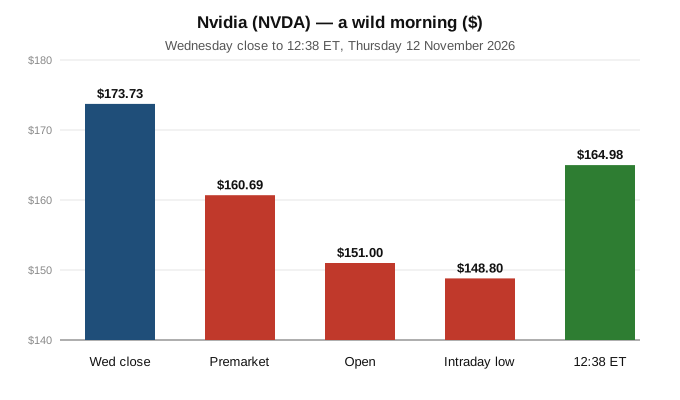
Nvidia: a 13% plunge at the open, then buyers step in
Nvidia (NVDA) is the whole story this morning. The stock is down 5.04% at $164.98 as of 12:38 ET, against Wednesday's close of $173.73 — but that single number hides a violent round trip. It opened at $151.00, down about 13%, touched an intraday low of $148.80, and has since recovered more than $16 from that low to trade as high as $167.14. It had already fallen about 7.5% in premarket trading to around $160.69, after dropping 8.61% in after-hours trading on Wednesday.
The trigger is governance, not demand. The Wall Street Journal reported that Nvidia's board is preparing to remove chief executive Jensen Huang, and Reuters reported that the board met late on Wednesday to discuss his future. Bloomberg reported that the board is working with an external firm to search for potential successors, and one report has chief financial officer Colette Kress favoured as interim chief. As of midday, no decision has been announced, and Morningstar reports that news on Huang's position is expected later on Thursday. Bernstein has cut its price target on the stock in half, from $400 to $200. The background is the board's independent investigation, announced on 8 November, into reports that Huang had been targeted by a foreign intelligence operation; the New York Times has since reported a second relationship, with a Nvidia executive. Nvidia reports third-quarter results on Tuesday 17 November, five days from now.
Why it matters: Nvidia has lost about 17.6% over the past five sessions and about 28% over the past month, and the selling this morning was not a slow drift — it was a gap down of 13% at the open, followed by buyers stepping in below $150. That is the market doing two things at once: pricing a genuine risk that the company loses the chief executive who built it, and deciding that at $150 the shares are cheap enough to buy anyway. For ordinary investors, the lesson is that a governance shock and a business shock are different things — the demand for Nvidia's chips has not changed overnight — but the market cannot price a leadership vacuum, so it prices the uncertainty instead. Watch for any statement from the board before the close, and whether the shares can hold above $160 into the afternoon.
The rotation: AMD and Broadcom gain, the rest of chips slide
The money leaving Nvidia is not leaving the chip sector entirely. AMD is up 4.69% to $578.85 as of 12:38 ET, against Wednesday's close of $552.90, after opening at $569.28 and touching a high of $594. Broadcom is up more than 2%, as investors bet that customers may diversify their chip purchases if Nvidia's leadership is in doubt. AMD is now up about 170% so far in 2026.
The rest of the sector is under pressure. The VanEck Semiconductor ETF is down 0.89% at midday, and Micron is down 5.1%. CoreWeave, which surged 24.71% on Wednesday after its earnings beat, is giving back part of that gain. The split is the day's clearest signal: investors are not abandoning AI spending, they are re-pricing who supplies it.
Why it matters: Wednesday showed the AI trade can still rally hard on real demand. Thursday shows how fast that rally reverses when the story shifts from earnings to governance — and how quickly the market looks for the next beneficiary. A rotation that sticks would say investors are re-pricing the AI supply chain; a rotation that fades by the close would say today was only a flight from one stock.
Lilly holds near its record as healthcare steadies the market
Eli Lilly (LLY) is up 0.85% at $1,449.45 as of 12:38 ET, against Wednesday's close of $1,437.29, after touching a high of $1,460 during the session. China has approved orforglipron, sold as Foundayo, as the country's first GLP-1 weight-loss pill — ahead of Novo Nordisk, whose oral Wegovy is still awaiting a Chinese decision. J.P. Morgan forecasts that China's GLP-1 weight-management sales could reach 30 billion yuan, about $4.5 billion, within five to seven years. Lilly's shares have gained about 35% so far in 2026, compared with an 18.6% fall for Novo Nordisk.
Why it matters: on a day when technology is dragging the indices lower, the morning's clearest company-specific win is coming from healthcare, not technology. The health care sector is up 0.32% at midday, and it is doing quiet defensive work while the chip sector argues with itself.
The rates backdrop: yields above 5%, small caps lagging
The other headwind has not gone away. The 10-year Treasury yield is around 5.05% to 5.07%, up about 7 basis points on the morning, after bond markets reopened following the Veterans Day closure. Markets are fully pricing in a December Federal Reserve rate hike, and Deutsche Bank now expects the Fed to raise rates at each of its next three meetings. The VIX, the market's fear gauge, is at 18.4, up from Wednesday's close of 17.49. Gold futures are down about 1.1% at $3,953.50, and the dollar is at a 19-month high, both consistent with higher yields and a flight to safety. Bitcoin is down 3.49% at $71,384.
Breadth is poor. The Russell 2000, the small-company index, is down 0.76% at midday, and the Dow's gain is being carried by value rather than growth: energy is the clear sector leader, with the Energy Select Sector SPDR up 1.65% and the Oil and Gas Exploration ETF up 1.94%, while utilities are up 0.67%. Overseas, the split is the same story in reverse: Asia was mostly lower overnight — the Hang Seng fell 1.2% and Taiwan's Taiex 2.6% — while Europe's STOXX 600 hit its first record high since August.
Why it matters: a market that rises on energy and utilities while small caps fall and yields climb is a market being careful, not a market being confident. The Dow's gain looks reassuring on its own, but it is a defensive gain. The test for the afternoon is whether the Nasdaq can follow the S&P 500 back above flat, or whether the chip selling resumes once the morning's bargain hunting is done.
What to watch next
After the close today, Applied Materials reports fourth-quarter earnings, with analysts expecting earnings per share of $4.06, and Cisco also reports — both are the next check on chip-equipment and AI-infrastructure demand after today's turmoil. October's Producer Price Index follows on Friday at 8:30 ET. And the date that matters most for the AI trade is Tuesday 17 November, when Nvidia reports third-quarter results — five days after a board meeting that may yet decide its chief executive's future.
For ordinary investors, the midday message is a useful one to hold on to: a market can open in panic and recover before lunch without anything being resolved. Nvidia is still down 5% on the day, the board has still said nothing, yields are still above 5% and the December hike is still fully priced in. The morning's buyers were brave, not certain — and the afternoon will show whether they were right.
For education only. Not financial advice.
Sources
- StockSetups: Stock Market Today, Nov 12 — S&P 500 +0.1%, Nasdaq 100 -0.1%, Dow +0.3%
- Pulsafi: Today's Market Pulse, November 12, 2026
- Finnhub: NVDA quote, 12:38 ET
- Finnhub: AMD quote, 12:38 ET
- Finnhub: LLY quote, 12:38 ET
- Stock Market Watch: Stock Market Today, Nov 12
- Zacks: Stock Market News for Nov 12, 2026
- Kitco / Reuters: Wall Street set to dip as Nvidia storm continues, Treasury yields bob at 5%
- Morningstar: Nvidia Leadership Crisis Drags on U.S. Stock Futures, Pressures AI Trade
- Finance TL;DR: Nvidia Board Weighs Replacing Jensen Huang as Stock Slides
- Curve Ahead: Market Structure — AI Leadership Meets a 5% Rate Test (November 12, 2026)
- OrbitLens 100: Stocks to watch today — Nvidia sinks as its board weighs ousting Jensen Huang