Market News
Midday: Nasdaq slides 1.7% as the chip sell-off deepens ahead of Nvidia earnings
As of 12:02 ET the Nasdaq Composite is down 1.7% and the S&P 500 down 1.2%, with Micron down 6.3% and AMD down 5.1% as the chip sell-off that began overnight in Taiwan deepens. Nvidia is down 3.9% ahead of Tuesday's earnings, Bitcoin has slipped to $64,184, and the Empire State manufacturing survey came in well below expectations.
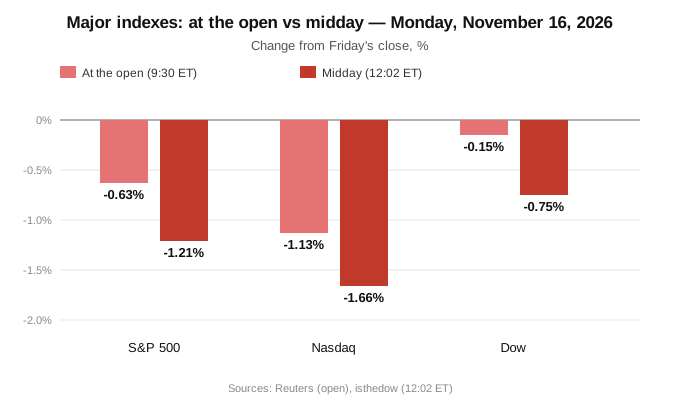
Monday 16 November, midday: the selling that started overnight in Taiwan has not let up — it has spread. Wall Street opened lower and drifted lower through the morning, extending Friday's losses into a third straight day of declines. As of 12:02 ET, the Nasdaq Composite is down 1.66% at 24,717.79, the S&P 500 is down 1.21% at 7,469.81, and the Dow Jones Industrial Average is down 0.75% at 51,952.68. The gap between the indexes is the story: the tech-heavy Nasdaq is falling more than twice as fast as the Dow, and the selling is concentrated exactly where the market's biggest gains of the year came from.
The trajectory through the morning has been one-way. The S&P 500 opened at 7,513.98, down 0.63% from Friday's close of 7,561.67; by 11:12 ET it was down 1.18%, and by 12:02 ET it was down 1.21%. The Nasdaq opened down 1.13% at 24,853.35 and has stayed near the day's lows since. The Dow opened down just 0.15% at 52,267.06 and has held up best all morning. The Russell 2000, the small-cap index, was down 1.15% at 2,758.32 in the late morning. The S&P 500 is still up 9.2% for the year, but it now sits 4.4% below its October 6 high, and the Nasdaq is down 5.5% over the past week.
Nvidia (NVDA): down 3.9% with earnings one day away
Nvidia (NVDA) is trading at $156.57 as of 12:40 ET, down 3.86% from Friday's close of $162.85. It opened at $159.02, briefly touched $163.20, and has since slid to near its low of the day at $156.50. The stock is down 16.1% over the past five sessions and 26.9% over the past month, and it now sits about 36% below its October 6 record of $243.37.
Why it matters: Tuesday's third-quarter results, due after the close, are the most important earnings report of the season — the company's first under interim chief executive Colette Kress, after Jensen Huang resigned on 12 November. Analysts are cutting targets into the report: Mizuho lowered its price target to $220 from $250 while keeping an Outperform rating, TD Cowen cut its target to $200 from $275 while keeping a Buy rating, and CLSA set a new target of $255. The message from Wall Street is the same as the message from the tape: the numbers on Tuesday have to be very good to stop this slide. Watch whether Nvidia can hold above its 52-week low of $148.80, set on 12 November — a break below it would put the year's lows squarely in play.
AMD, Micron and Intel: the chip sell-off is broadening, not fading
Advanced Micro Devices (AMD) is down 5.07% at $507.00 as of 12:40 ET, after falling 8.75% on Friday. It opened at $503.45 and has traded in a narrow range since, with a low of $502.22. Micron (MU) is down 6.31% at $729.18, after opening at $734.16 and touching a low of $717.40 — well below its Friday low of $750.25. Intel (INTC) is down about 6%, and TSMC (TSM), whose Taipei-listed shares fell 5.74% overnight as Taiwan's Taiex dropped 6.03%, is caught in the same downdraft.
Why it matters: this is no longer a Nvidia-only story, and it is no longer a one-day story. The memory names — Micron and SanDisk — are falling as fast as the AI names, which tells you investors are questioning both data-centre spending and memory pricing at the same time. When the supposed rivals fall as hard as the leader, the market is repricing the whole AI trade, not rotating within it. The Philadelphia Semiconductor Index fell 3.43% on Friday, and today's action says that decline is continuing.
Empire State survey: factory growth cools sharply
The morning's economic data did not help. The New York Fed's Empire State manufacturing survey fell to 7.8 in November from 25.5 in October, well below the 16.7 economists expected. New orders barely grew, dropping to 3.0 from 23.2, and shipments eased to 8.8. The details were mixed rather than uniformly bad: hiring strengthened sharply, with the employment index jumping to 18.1, its highest since June 2022, and price pressures eased, with the prices-paid index falling 14 points to 45.9. Firms also turned more optimistic about the future, with the future business conditions index rising eight points to 28.9.
Why it matters: a reading above zero still means factories are expanding, so this is a slowdown, not a contraction. But the miss was large, and it landed on a morning when the market was already nervous. Federal Reserve Chair Kevin Warsh speaks at noon ET at the Fed's conference on productivity and jobs, and his remarks will be read for any signal on the December meeting, where markets still expect a rate increase. The 10-year Treasury yield is hovering around 5.13% to 5.15%, and the VIX, the market's fear gauge, is at 20.7, up from 19.30 at Friday's close.
The exceptions: Tyson Foods jumps, defensives hold up
Not everything is falling. Tyson Foods (TSN) is up 7.3%, the day's standout gainer, after encouraging fiscal 2027 guidance overshadowed a fourth-quarter earnings miss. Real estate is leading the sector gains while communication services is suffering the steepest losses, and health-care names that rose in premarket trading are holding up better than the market.
Why it matters: the market is still discriminating. A company with a credible outlook is being rewarded even on a day when the indexes are down more than 1%. The rotation out of high-multiple technology names and into steadier earners is the mirror image of the chip sell-off — money is moving, not just leaving. Watch whether that defensive bid survives the afternoon: if technology stabilises, the rotation may pause; if the selling spreads, the Dow's resilience will be tested too.
Bitcoin and gold: risk appetite is fading across the board
Bitcoin is down 1.72% at $64,184 as of 11:12 ET, its lowest level since July, and it is now down 16% so far in November after briefly touching about $62,000 over the weekend. Strategy (MSTR), the largest corporate holder of Bitcoin, is down about 7%, hurt both by the Bitcoin slide and by its removal from MSCI's equity indexes, which could reduce demand from passive funds. Gold, usually a refuge when stocks fall, is down 0.61% at $3,862.60.
Why it matters: when Bitcoin, gold and stocks all fall together, it is a sign that investors are raising cash rather than rotating into safety. Bitcoin has been trading like a high-beta technology stock, and today it is doing exactly that — falling further than the Nasdaq. Watch the $62,000 weekend low: a break below it would put the four-month low squarely in play.
What to watch into the close
- Nvidia's earnings on Tuesday 17 November, after the close — the week's main event, and the report that decides whether this sell-off is a correction or something longer.
- US retail sales on Tuesday, and Home Depot (HD) and Walt Disney (DIS) reporting before the open the same day.
- Fed Chair Kevin Warsh's remarks at noon ET, and the Federal Open Market Committee's meeting minutes on Wednesday.
- Walmart (WMT) reports on Thursday, the next big read on consumer spending heading into the holiday season.
- The 10-year yield: above 5.15% it keeps pressure on growth stocks; a retreat would ease it. And whether the Dow can keep holding near flat while the Nasdaq falls — if the selling spreads from chips into the broader market, the afternoon will look very different from the morning.
For education only. Not financial advice.
Sources
- Reuters via KWSN: Nasdaq falls 1% at open as Nvidia woes weigh on sentiment ahead of earnings
- The Motley Fool: Stock Market Midday, Nov. 16: Nasdaq Tumbles as Wall Street Braces for Nvidia Earnings and Bitcoin Slides
- Pulsafi: Today's Market Pulse — November 16, 2026
- isthedow: Is the Nasdaq Up or Down Today?
- Finnhub: NVIDIA Corporation (NVDA) market data
- Finnhub: Advanced Micro Devices (AMD) market data
- Finnhub: Micron Technology (MU) market data
- MarketBeat: AMD, NVDA, SOXX, ON, and MU analyst ratings
- Morningstar / Dow Jones: New York Manufacturing Activity Moderates from October Surge
- Zacks: Stock Market News for Nov 16, 2026
- The Edge: US Market Wrap 16 November — Early Session, Tech Leads Stocks Lower Before Nvidia Results
- StockSetups: Stock Market Today Nov 16 — S&P 500 -1.4%, Nasdaq 100 -2.1%, Dow -0.8%