Learn
Diversification: why owning many things beats betting on one
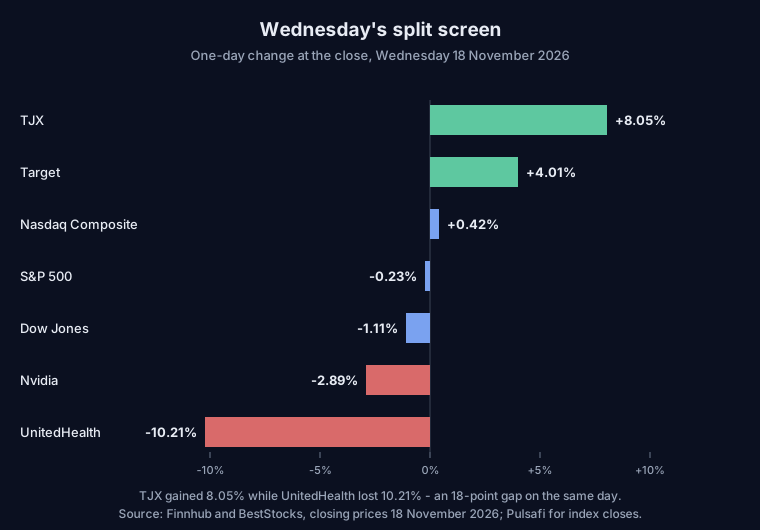
On Wednesday, TJX rose 8.05% while UnitedHealth fell 10.21% — and the S&P 500 barely moved. The same market, wildly different days. That gap is what diversification is for: no single company's bad day should decide your outcome.
Wednesday 18 November was a split screen. The S&P 500 fell 0.23% to 7,323.63, its fifth straight loss; the Nasdaq Composite rose 0.42% to 24,429.88; and the Dow Jones Industrial Average fell 1.11% to 50,198.17. Read those three numbers and the day looks quiet. Look underneath them and it was anything but.
TJX (The TJX Companies) jumped 8.05% to $140.30 after strong results. Target (TGT) rose 4.01% to $165.93. Nvidia (NVDA) fell 2.89% to $150.96 — the day after reporting revenue of $115.84 billion, up 103% from a year earlier. And UnitedHealth (UNH) plunged 10.21% to $349.91.
Same market, same day. An investor who owned only UnitedHealth lost a tenth of their money. One who owned only TJX gained 8%. One who owned the whole market lost 0.23%. That gap — between one company's day and the market's day — is the whole idea of diversification.
What diversification is
Diversification means owning many different investments, so that no single company's fate decides your outcome. It is the oldest advice in investing — don't put all your eggs in one basket — and it is also the one with the most maths behind it.
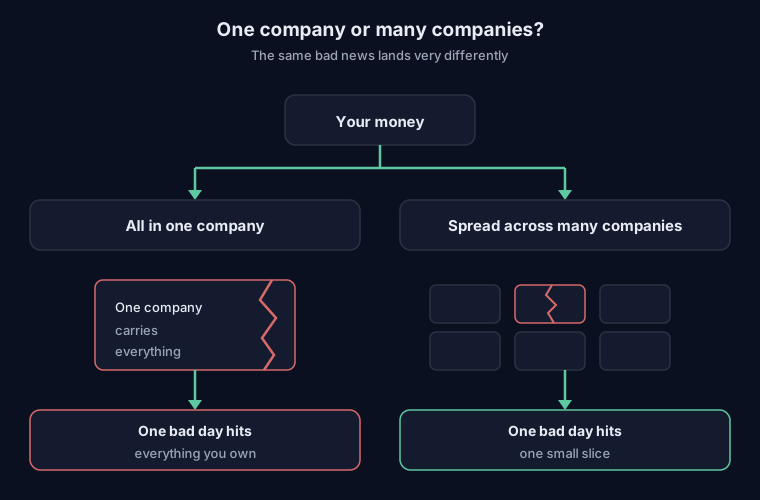
Think of it as the difference between one company and many. If all your money sits in one stock, one bad piece of news — a chief executive resigning, a regulator proposing a new rule, a quarter that disappoints — lands on your entire portfolio. If your money is spread across many companies, the same bad news lands on one small slice, and the rest carries on.
Two kinds of risk
To see why this works, split risk into two kinds.
Company-specific risk belongs to one business alone: a failed product, a lawsuit, a leadership change. Nvidia's week is a good example — the company doubled its revenue and the shares still fell, because the market was worried about who runs the company next. That is Nvidia's risk, not the market's.
Market risk belongs to everything at once: interest rates rise, a recession arrives, investors decide to sell. When that risk shows up, nearly all stocks fall together, and owning more of them does not help. Wednesday was the S&P 500's fifth straight down day, and no amount of spreading across stocks would have turned it positive.
Diversification removes the first kind of risk. Nothing removes the second. That distinction matters, because it sets honest expectations: a diversified portfolio still loses money in a falling market. It just does not lose 10% because one company had a bad day.
The maths: most of the benefit comes early
The surprising part is how few holdings it takes to get most of the benefit. Academic work going back to Evans and Archer (1968), refined by Statman (1987), shows the same curve again and again: portfolio volatility falls steeply with the first few stocks, then flattens. The usual textbook numbers, assuming an average stock volatility of about 35% a year and an average pairwise correlation of about 0.30, look like this: one stock, about 35% volatility; five stocks, about 22%; ten stocks, about 19%; twenty stocks, about 17%; thirty stocks, about 16.5%.
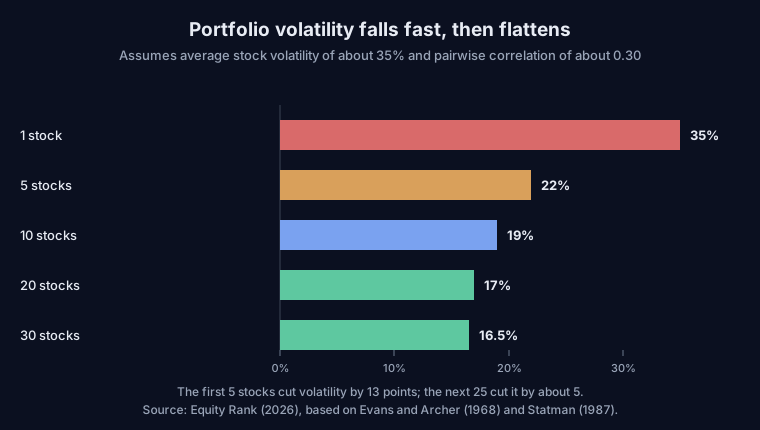
Read that chart from left to right and the lesson is plain. The first five stocks cut volatility by 13 points. The next twenty-five cut it by about five more. Somewhere around twenty to thirty holdings, a stock-only portfolio has captured most of what diversification can offer. After that, each new name adds complexity and trading cost for almost nothing.
There is a floor, and it is the market risk from the section above. Even with hundreds of stocks, volatility settles near the market's own level — about 16% in this illustration — and never reaches zero. Diversification smooths the ride; it does not remove the road.
Wednesday, through a diversified lens
Go back to Wednesday's numbers and the maths becomes concrete. The four big movers of the day were TJX at +8.05%, Target at +4.01%, Nvidia at -2.89% and UnitedHealth at -10.21%. The simple average of those four is -0.26% — almost exactly the S&P 500's -0.23%.
That is not a coincidence. It is diversification doing its job in miniature: the winners and the losers partly cancelled each other out, and what was left was roughly the market's own move. The investor holding all four felt a quiet day. The investor holding only one of them felt a very loud one.
Monday told the same story from the other side. Nvidia fell 4.12% while the S&P 500 fell 1.92% — the single stock moved more than twice as far as the market, in the same direction, on the same news.
How to diversify in practice
Across companies. Twenty stocks is a reasonable target for a stock portfolio, but they have to be genuinely different businesses. Twenty chipmakers is not twenty bets; it is one bet wearing twenty costumes. On Monday 16 November the PHLX Semiconductor Index fell 5.28% in a single session — every chip stock fell together.
Across sectors. Retailers rose on Wednesday while health insurers fell. Different industries answer to different forces: consumers, interest rates, regulation, commodity prices. Owning several sectors means one industry's bad day is not your bad day.
Across asset classes. Stocks are only one kind of asset. Bonds, cash and other assets move differently again — the 10-year Treasury yield ended Wednesday at 5.07%, so bonds now pay a real income while stocks wobble. A portfolio that mixes stocks with bonds has a second cushion that stocks alone cannot provide.
Across countries. Different economies move on different cycles. A portfolio that owns only American companies is a bet on one economy, however many names it holds.
The simple route. A broad index fund does the company-level work in one trade: it owns hundreds of companies at once, so one company's 10% fall becomes a fraction of a percent for the fund. That is why Monday's index investor lost 1.92% while the Nvidia-only investor lost 4.12%.
Rebalance. Diversification drifts. The winners grow and quietly become a bigger share of the portfolio, until the mix you planned is no longer the mix you own. Checking the balance once or twice a year — trimming what grew, topping up what shrank — keeps it honest.
What beginners get wrong
Owning twenty stocks in one industry and calling it diversified. If they all rise and fall together, you own one risk, not twenty. Spread across industries, not just across tickers.
Expecting diversification to prevent losses. It prevents single-company losses, not market losses. In a broad sell-off, correlations rise: the things that usually move independently start moving together, and the diversified portfolio falls with the market. That is the week we are having — five straight down days for the S&P 500 — and it is normal.
Over-diversifying. Owning hundreds of individual stocks adds paperwork, trading costs and positions too small to matter, for almost no extra risk reduction. The chart above shows why: past thirty names, the curve is nearly flat.
Chasing the hot stock after it has run. Nvidia doubled its revenue and still fell 2.89% on Wednesday, because the good news was already in the price. Buying the story everyone already knows is not diversification; it is concentration at the worst moment.
Setting it once and forgetting it. A portfolio left alone concentrates itself. The winners take over, and five years later the careful spread has become a bet on whatever went up most.
What to watch next
Walmart reports before the open on Thursday, the next big read on consumer spending after TJX and Target's strong numbers. Alibaba also reports on Thursday. Anthropic is reported to have priced its IPO at $83. The Federal Reserve meets next on 8–9 December, and Wednesday's Fed minutes pointed toward another rate rise.
Whatever those days bring, the question in this article stays the same: would you rather feel one company's day, or the market's? Wednesday's answer was an 18-point gap between the best and worst of four big names — and 0.23% for the investor who owned a piece of all of them.
This article is for education only. It is not financial advice.
Sources
- Pulsafi: Today's Market Pulse — November 18, 2026
- Longbridge: US Market Diary, November 18, 2026
- BestStocks: Stocks on the Move, Nov 18 — TJX +8.05%, UNH -10.21%, TGT +4.01%
- Finnhub: NVDA quote — close $150.96, -2.89% on 18 November 2026
- World Money Roadmap: Fed Minutes Back More Hikes; Nvidia -2.89%, Nasdaq +0.42%
- Equity Rank: Portfolio Concentration Explained — diversification math, Evans and Archer (1968), Statman (1987)