Learn
How to read an earnings report: why a beat can still fall 6%
Cisco beat expectations on Friday — record revenue of $18.5 billion, earnings of $1.40 a share against $1.33 expected — and fell 6.2%. On the same day, Cerebras rose 11.2% and Nu Holdings 11.8% on their own results. With 84% of S&P 500 companies beating earnings this season, a beat alone tells you almost nothing. Here is what to actually read in a report.
Friday 13 November ended a strange week with a small down day: the S&P 500 fell 0.40% to 7,561.67, the Nasdaq Composite slipped 0.91% to 25,136.27 and the Dow Jones Industrial Average rose 0.10% to 52,347.55. But the day's real lesson was not in the indexes. It was in the earnings reports.
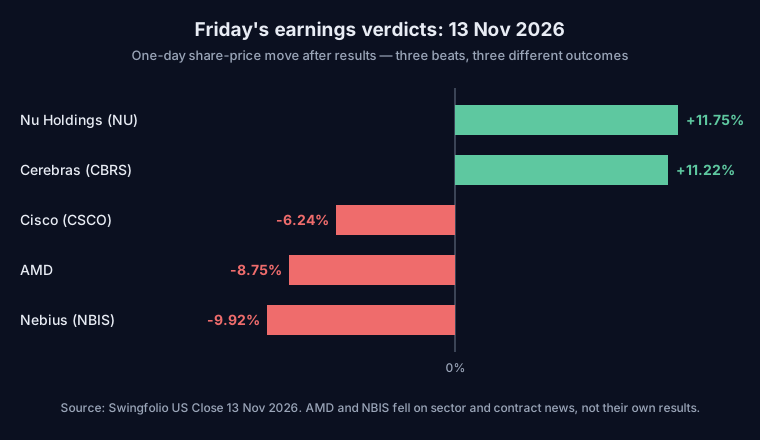
Cisco (CSCO) reported record revenue of $18.5 billion, up 24% from a year earlier, and adjusted earnings of $1.40 a share against the $1.33 analysts expected — a clean beat on both headline numbers — and its shares fell 6.24%. On the very same day, Cerebras (CBRS) rose 11.22% on its results and Nu Holdings (NU) jumped 11.75% on record quarterly profit. Three companies, three beats, three completely different verdicts.
That is why reading an earnings report is a skill worth learning. The headline number is the least informative part of it.
What an earnings report actually is
Four times a year, every listed company publishes a report card: how much money came in, how much it kept, and what it expects next. The release usually lands after the market closes or before it opens, and it comes in two parts — a press release with the numbers, and a conference call where executives explain them and take questions from analysts.
The whole event takes about an hour, but the market reacts in seconds. That speed is exactly why beginners get confused: the first move is often a reaction to one number, and the lasting move comes later, once people have read the rest.
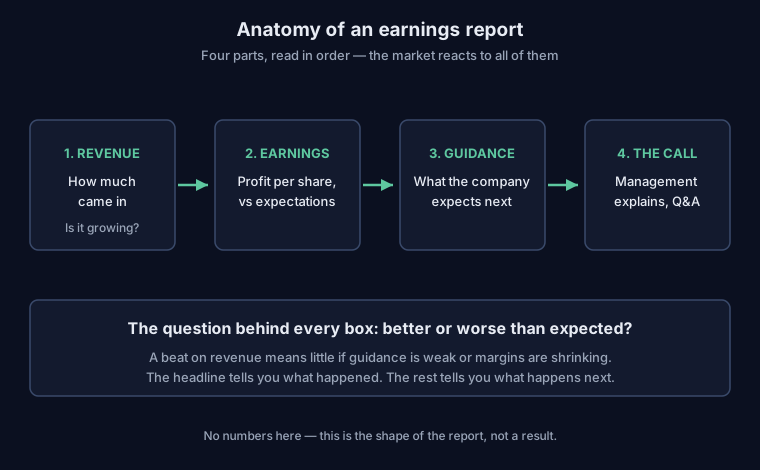
The three numbers everyone checks first
Revenue. How much money the company took in during the quarter. Cisco's $18.5 billion was a record, up 24% year over year. Revenue answers the simplest question: is the business growing?
Earnings per share (EPS). Profit divided by the number of shares. This is the number the headlines quote, and it is always judged against what analysts expected — the consensus estimate. Cisco earned $1.40 a share against $1.33 expected. Beating the estimate is called a "beat"; falling short is a "miss".
Guidance. What the company expects next quarter and next year. This is a forecast, not a result, and it is often the most important number in the whole release. A great quarter with weak guidance will usually fall; a weak quarter with strong guidance can rise. Cerebras (CBRS) rose 11.22% on Friday largely because it raised its full-year revenue outlook to $940 million to $960 million — the future mattered more than the past.
Why a beat can still fall: Cisco on Friday
Cisco beat on revenue and on earnings, raised its outlook, and still fell 6.24% — the biggest loser in the Dow on Friday. The reasons were in the parts of the report that never make the headline:
Margins shrank. Adjusted gross margin fell to 63.7% from 65.5%. The company sold more, but kept less of each dollar. When a business grows revenue 24% and its margins go backwards, investors start asking whether the growth is profitable growth.
Orders disappointed. Product orders grew 21% — a strong number on its own, but below what analysts expected, and slower than the previous quarter. Orders are a window into the future: they show what customers are committing to buy next. A beat today with weakening orders reads as a peak, not a platform.
The bar was already high. Cisco's shares had risen on Thursday, the day before the report. Some of the good news was already in the price, so the market needed more than a beat — it needed a reason to pay even more. It did not get one.
Compare that with the day's winners. Nu Holdings (NU) reported record third-quarter net income of $1.1 billion, up 31% from a year earlier, and rose 11.75%. Cerebras (CBRS) reported a surprise adjusted profit, raised its outlook, and added Microsoft (MSFT) as a cloud customer — three pieces of good news at once — and rose 11.22%. The market does not reward beating expectations. It rewards beating them in the places that matter for the future.
The parts beginners skip
Margins. Revenue tells you how much came in; margins tell you how much stayed. A company can grow sales and still become less profitable, as Cisco showed on Friday.
Cash flow. Profit on paper and cash in the bank are not the same thing. A company can report strong earnings while its cash flow weakens, because customers are paying late or inventory is piling up. Cash flow is harder to dress up than earnings.
The conference call. Executives explain the numbers, and analysts ask pointed questions. The tone matters: confident answers about demand and pricing carry weight; evasive answers about a weak division do too. Many of Friday's moves took shape during and after these calls, not at the headline.
Buybacks and dividends. Some companies return cash to shareholders by buying back shares or paying dividends. A buyback can lift earnings per share without the business improving at all — the same profit divided by fewer shares. It is worth knowing whether EPS grew because the business grew or because the share count shrank.
The season in numbers
This earnings season has been strong by almost every measure — and that is part of the lesson. According to FactSet, with 88% of S&P 500 companies having reported third-quarter results as of 6 November, 84% beat earnings estimates, above the five-year average of 78%, and 74% beat revenue estimates, above the five-year average of 70%. Blended earnings growth for the quarter stands at 31.4% year over year. Yet the average beat was only 2.7% above estimates — the smallest earnings surprise since the fourth quarter of 2022.
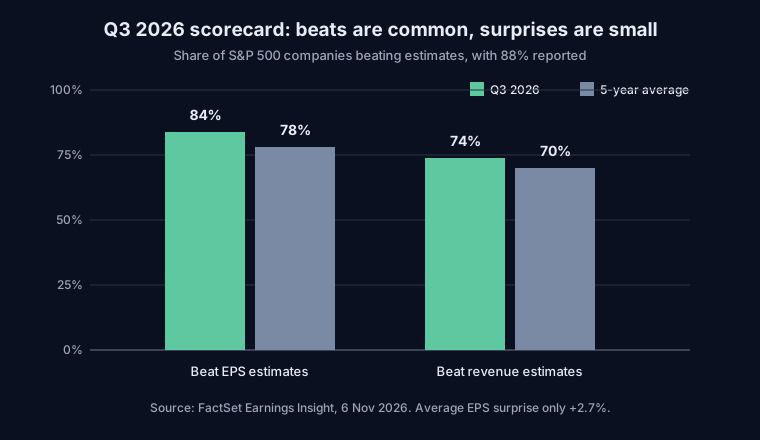
Read that together and the message is clear: beating expectations is normal — four out of five companies do it. A beat is not, by itself, a reason to buy. What moves a stock is the size of the surprise, the direction of guidance, and whether the details underneath — margins, orders, cash — support the headline.
What beginners get wrong
Treating a beat as a buy signal. Most companies beat. The market knows it, and the price usually reflects it before the report. The question is never "did it beat?" but "did it beat by enough, in the right places, with a better outlook?"
Comparing with last year instead of with expectations. A company can grow profit 30% and still fall, if analysts expected 40%. Stocks move on the surprise relative to expectations, not on the growth rate alone. Advanced Micro Devices (AMD) fell 8.75% to $534.06 on Friday after rising 44.7% over the previous five sessions — the bar for its next report is now much higher.
Ignoring guidance. The quarter just reported is history. Guidance is the only forward-looking number in the release, and the market trades the future. A company that beats and guides lower will usually fall.
Reading the first move as the final verdict. Shares often swing wildly in after-hours trading on the headline, then settle in a different place once the call is digested. Friday's tape was full of that: Broadcom (AVGO) fell 4.76% on the day but finished the week up 18.16%, and Nebius (NBIS) fell 9.92% on a report that Microsoft is reviewing its cloud contracts — a story that has nothing to do with its own earnings at all.
What to watch next
The earnings season is not over. Nvidia (NVDA) reports third-quarter results after the close on Tuesday 17 November — its first report since chief executive Jensen Huang resigned. The stock fell 2.01% to $162.85 on Friday, about 32% below its record close of $239.24 on 6 October, and the report is now the week's main event. Home Depot and Disney report on Tuesday as well, and Target and Lowe's on Wednesday. October retail sales arrive on Tuesday morning, and Anthropic is expected to price its IPO on Wednesday.
When those reports land, skip the headline first. Read revenue, then earnings against expectations, then guidance — and then the margins, the orders, and what management says on the call. The headline tells you what happened. The rest tells you what happens next.
This article is for education only. It is not financial advice.