Learn
Stop-losses: the exit you decide before you buy
Nvidia fell about 10% in two sessions, then bounced 2.9% on Wednesday. A stop-loss would have sold it before the rebound — which is exactly why the tool is so misunderstood. Here's what a stop-loss is, how to set one, and where it goes wrong.
On Wednesday 11 November, the market staged a sharp rebound. The S&P 500 rose 1.31% to 7,619.38, the Nasdaq Composite gained 1.60% to 25,466.19 and the Dow added 0.49% to 52,486.49. CoreWeave jumped 24.71% to $60.77 after raising its revenue outlook, and Nvidia rose 2.92% to $173.73 — after falling nearly 10% over the first two trading days of the week. Microsoft went the other way for a second day, down 2.26%.
Nvidia's week is the perfect case study for today's topic. An investor who bought the stock near the start of the week and set a 10% stop-loss would have been sold out on Tuesday — and then watched the shares rise almost 3% on Wednesday. Was the stop-loss a mistake? The answer is no, and understanding why is the whole point of the tool.
What a stop-loss is
A stop-loss is an instruction to your broker: sell this holding automatically if the price falls to a level you choose in advance. You set it when you buy, while you are calm, and it fires without asking you again.
That timing is the point. Every investor knows they should sell a loser before it becomes a disaster, and almost nobody does it in the moment — because in the moment there is always a reason to wait one more day. A stop-loss moves the decision from the worst possible time, when you are watching red numbers and hoping, to the best possible time, before you own the stock at all.
It is not a prediction. A stop-loss does not say the stock will keep falling. It says: if I am wrong about this trade, this is the most I am willing to lose finding out.
Why small losses matter: the maths of getting back to even
The reason to cap a loss early is arithmetic, not psychology. A loss and the gain needed to recover from it are not the same size, because the gain is measured on a smaller pot of money.
Put $1,000 into a stock and lose 10%, and you have $900. To get back to $1,000 you need $100 on $900 — an 11.1% gain. Lose 20% and you need a 25% gain. Lose 30% and you need 42.9%. Lose half your money and you need to double what is left — a 100% gain — just to stand still.
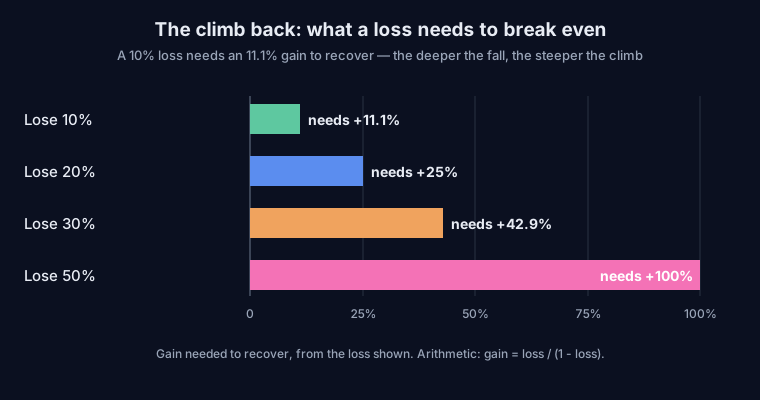
That is the real job of a stop-loss: not to avoid losing money — every investor loses money sometimes — but to keep each loss small enough that recovery is still realistic. A 10% loss is a setback. A 50% loss is a hole that takes a doubling to climb out of.
Three ways to set one
A fixed percentage below your entry. The simplest version: sell if the stock falls 7% to 10% below what you paid. It is easy to apply to every position, and it is the version most beginners start with. Its weakness is that it ignores the stock itself — a calm, slow-moving stock and a wild one get the same treatment.
Below a support level. This is where the support and resistance lesson comes back in. If a stock has repeatedly bounced off $160, a stop just below $160 means you are only sold out when the level that was supposed to hold has actually broken. The exit is tied to the market's own structure, not to an arbitrary number.
Based on volatility. A stock that normally moves 3% a day needs a wider stop than one that moves 0.5% a day, or normal noise will trigger it. One common rule is to set the stop a multiple of the stock's average daily move below the entry — far enough that an ordinary bad day does not sell you out, close enough that a genuinely bad one does.
A related tool is the trailing stop: instead of a fixed price, the stop rises with the stock — say, 10% below the highest price it has reached since you bought. It locks in gains as the stock climbs, while still giving it room to move. But it has the same weakness as every stop: in a sharp, sudden fall it can sell you out at the worst moment.
What beginners get wrong
Setting the stop too tight. This is the Nvidia lesson. A stop 3% below your entry will be hit by an ordinary bad week, and you will spend your time being sold out of stocks that then recover. The two-day, nearly 10% fall in Nvidia this week would have triggered almost any tight stop — and the shares then rose 2.9% on Wednesday. A stop that is too close does not protect you; it guarantees you sell low.
Moving the stop down when it is about to be hit. The moment the price approaches your stop, the temptation is to give it "a bit more room". Every time you do that, the stop stops being a rule and becomes a suggestion — and a suggestion will not protect you when you need it most. If the level was wrong, change it before you buy, not while the trade is going against you.
Thinking a stop-loss controls your risk on its own. A stop sets the maximum loss per share, but your total risk depends on how many shares you own — that is position sizing, the topic of an earlier article in this series. A 10% stop on a position that is half your portfolio is still a 5% loss on everything you own.
Forgetting that a stop does not protect against gaps. A stop-loss becomes a market order when the price is reached, and it sells at the next available price — not necessarily at your stop level. If a stock closes at $170 and opens at $155 after bad news overnight, your $160 stop sells at $155, or lower. Nvidia recovered from a premarket drop of about 6% on Wednesday before closing higher — a stop set below Tuesday's close could have sold near the morning low, before the recovery ever happened. Earnings are the classic gap risk: Nvidia reports its own results on Tuesday 17 November, and a stock can jump or fall 10% overnight on the numbers.
What to watch next
Nebius reports third-quarter results before Thursday's open, weekly jobless claims arrive at 08:30 ET on Thursday, and Cisco reports after the close. October's Producer Price Index lands at 08:30 ET on Friday. And the date that matters most for the stop-loss lesson is Tuesday 17 November, when Nvidia reports: a stock that has already swung 10% in a week can gap far past any stop on earnings day. The question to ask before the event, not after it, is whether you want to hold through it at all.
A stop-loss will never make you money. It will sometimes sell you out of a stock that bounces the next day, and you will feel foolish — Nvidia's Wednesday rebound is exactly that feeling. But its job is not to be right every time. Its job is to make sure that no single mistake, no single bad week, and no single piece of bad news can do damage you cannot recover from. That is a smaller promise than most trading advice makes — and a more useful one.
This article is for education only. It is not financial advice.