Market News
Midday: hot CPI sinks stocks — the 10-year yield tops 5% and Nvidia slides again
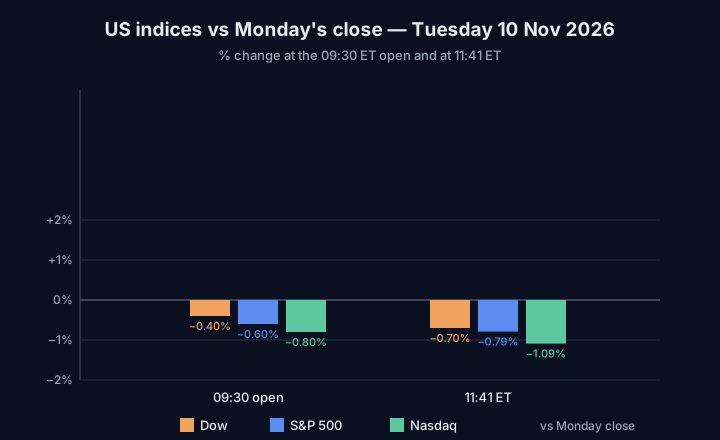
By midday the S&P 500 is down 0.8% and the Nasdaq 1.1% after October inflation came in hotter than expected — the 10-year Treasury yield has crossed 5%, December hike odds are up to 85%, and Nvidia has fallen another 6.8% while most of its chip peers rise.
Tuesday 10 November, midday: Monday's relief rally lasted less than a day. As of about 11:41 ET, the S&P 500 is down 0.79% at 7,490, the Nasdaq Composite is down 1.09% at 24,987 and the Dow Jones Industrial Average is down 0.70% at 52,039. The slide has deepened through the morning: the indices opened lower — the Dow down 0.4%, the S&P 500 down 0.6% and the Nasdaq down 0.8% — and drifted further down rather than recovering. The Nasdaq has slipped back below 25,000, giving back more than a third of Monday's 2.74% surge.
The trigger arrived before the bell, and it was the number the whole week was waiting for.
Figures in this article are intraday snapshots captured in New York between the open and about 12:39 ET. The session had not closed when this was written.
The CPI report: hotter than expected, again
October consumer prices rose 0.4% month over month, the Bureau of Labor Statistics reported at 08:30 ET, above the 0.3% economists had forecast. Core CPI — which strips out food and energy — rose 0.3%, also above the 0.2% expected, and has now printed at 0.3% for three straight months. Shelter costs rose 0.3% and accounted for more than 30% of the monthly increase; food prices climbed 0.5% and energy rose 0.7%, a sharp slowdown from September's 5.2% jump. The headline pace did cool from September's 0.6%, but cooling more slowly than expected is not the same as cooling enough.
There is no year-over-year figure in this report: last year's government shutdown stopped the Bureau of Labor Statistics collecting price data last October, so no comparable index exists. The last full annual reading, for September, showed prices up 3.7% from a year earlier — well above the Federal Reserve's 2% goal.
Why it matters: this was the last inflation report before the Fed's final meeting of the year on 8–9 December, and the market's read is unambiguous. The odds of a rate hike in December have risen to 85%, according to the CME FedWatch tool, up from 82.2% before the report — and the debate is no longer only about whether the Fed hikes, but by how much. Fed Governor Christopher Waller said on Tuesday that he supports a December hike and would back a 50-basis-point increase if inflation keeps accelerating; core CPI landing exactly on the 0.3% line Waller had set made that warning hard to ignore. Morgan Stanley's global head of macro strategy, Matthew Hornbach, pushed back on CNBC, calling a half-point move "too far" — but the market is pricing the risk, not the reassurance.
Yields cross 5%, gold slides, fear returns
The bond market reacted first and hardest. The 10-year Treasury yield climbed to 5.02%, up 0.12 percentage points on the day — crossing the 5% line that tends to focus minds on Wall Street. Higher yields make borrowing more expensive for companies and make safe returns on bonds more attractive relative to stocks, which is why growth stocks are leading today's slide. The Motley Fool notes that some AI firms have taken on significant debt to fund infrastructure, so a higher-for-longer rate path hits them twice: dearer borrowing and a lower value placed on future earnings.
Gold fell 2.82% to $4,023.75 an ounce, and the VIX — the market's fear gauge, which closed Monday at 19.92 after falling 22% — has pushed back above 20. The relief of Monday's rally is being repriced in real time.
Nvidia slides again — down nearly 7% by midday
The day's most striking single-stock move is Nvidia (NVDA), down 6.82% to about $166.48 as of 12:39 ET, after opening at $173.97 and touching an intraday low of $166.46. That follows Monday's 4.3% drop to $178.67, so the stock has now lost more than a tenth of its value in two sessions and is approaching its 52-week low of $164.27. The board's investigation into chief executive Jensen Huang — over reports of his links to a businesswoman US intelligence agencies allege is a Chinese spy — still hangs over the stock, and a securities-fraud class action against the company and Huang was also reported on Tuesday. The allegations have not been independently verified.
Why it matters: Nvidia is the market's most valuable company, and its slide is doing much of the damage to the Nasdaq today. The stock is now down about 11% for the year, and the selling has not spread to the rest of the chip sector — which is precisely what makes it a company story rather than a sector story. Nvidia reports third-quarter results on 17 November, the next scheduled chance for management to address investors.
Chips split: money leaves Nvidia, not the sector
Remarkably, the rest of the chip complex is rising while Nvidia falls. As of mid-morning, AMD was up 3.32% to $525.56, Broadcom (AVGO) was up 3.17% and TSMC was up 1.89%. The Philadelphia Semiconductor Index (SOX) was down only 0.32% — a small decline for an index that includes Nvidia — which means the rest of its members are, on balance, holding up.
Why it matters: this is the mirror image of Monday, when the whole chip sector rallied except Nvidia. Investors are still buying chips and AI infrastructure; they are just not buying the one stock carrying a governance question. For ordinary investors, the lesson is that a single stock and a whole theme are different things — and today the market is drawing that line very clearly.
Earnings movers: Sanmina fades, Rocket Lab recovers, Take-Two climbs
The morning's earnings stories have mostly been overwhelmed by the CPI reaction, but the individual moves are instructive. Sanmina (SANM), the morning's star, surged about 19.5% premarket to around $179.65 on a thumping fourth-quarter beat and strong fiscal 2027 guidance — revenue jumped 84% year over year to $3.86 billion and cloud and AI infrastructure revenue soared 179% — but the gain has almost entirely evaporated: the shares opened at $166.40 and were trading near $151.02 by 12:39 ET, up less than 1% on the day. A great earnings report could not hold its ground against a hot inflation print.
Sally Beauty (SBH) has held up better, up 2.92% to $20.06 at 12:38 ET after a fourth-quarter earnings beat, trading above its recent 52-week high. Rocket Lab (RKLB) has staged the day's most complete reversal: down about 8% premarket to around $54.10 after its Neutron rocket slipped into 2027, the shares opened at $54.99 and climbed to $59.93 by 12:39 ET, up 1.82% on the day — the record $267.8 million in quarterly revenue and $3.57 billion backlog winning out over the delay. Take-Two (TTWO) is up about 4% on its second-quarter results and the Grand Theft Auto VI launch nine days away, with the shares touching a day high near $229 in the morning.
On the losing side, GE Vernova (GEV) was down about 7% in mid-morning trading, giving back more of Monday's gains as investors keep questioning the pace of AI data-centre spending.
Breadth: energy alone in the green
The decline is broad. Energy stocks were the only real gainers this morning, even as oil prices kept falling — WTI crude was down about 2.2% premarket to $84.93 a barrel on hopes the Iran conflict may end soon. Basic materials saw the biggest drop, followed by technology. That is the reverse of Monday, when all eleven S&P 500 sectors rose and roughly 418 stocks advanced against 80 that fell. Today's message is the opposite: one hot number has put the whole market on the defensive, and only the sector least sensitive to interest rates is holding up.
What to watch next
The afternoon still holds two set pieces. A $42 billion 10-year Treasury note auction is at 13:00 ET — a weak auction would push yields higher still — and Fed officials Schmid and Bowman speak later in the day. After the close, CoreWeave (CRWV) headlines the earnings calendar, and its AI spending and financing will be under close scrutiny in a session that has punished leveraged AI names. The Producer Price Index follows on Friday 13 November. Tomorrow is Veterans Day: the bond market is closed, but US stock markets are open as usual.
For ordinary investors, the midday message is a useful one to hold on to: a single inflation report can erase a day's relief rally in a morning, and the market's verdict today is not that the economy is weak — earnings like Sanmina's and Rocket Lab's are genuinely strong — but that inflation is still too hot for the Fed to stop tightening. The December meeting on 8–9 December is now the date that matters, and this report has made a hike more likely and a bigger one thinkable.
For education only. Not financial advice.
Sources
- Motley Fool: Stock Market Midday, Nov. 10 — Stocks Slide on Hot Inflation Data
- Reuters via SRN News: Hot October inflation report rattles markets
- MPA Magazine: Mortgage rates set to rise as October CPI tops forecasts
- Stocktwits: October CPI Comes In Hotter Than Expected — Morgan Stanley Strategist Says 50-Basis-Point Fed Hike Would Be 'Too Far'
- Finnhub: NVDA quote, 12:39 ET
- Finnhub: SANM quote, 12:39 ET
- Finnhub: RKLB quote, 12:39 ET
- Finnhub: SBH quote, 12:38 ET
- Baystreet: Stocks Stumble by Noon
- KuCoin News: U.S. Major Stock Indices Open Lower Amid Rising Inflation and Expectations of Fed Rate Hikes
- Traders Union: Sanmina shares jump as upbeat outlook lifts U.S. market movers
- OrbitLens 100: Stocks to watch today — CPI day, futures flat after Monday's best session since April