Market News
Midday: CoreWeave ignites an AI chip rally — Nasdaq leads while the Dow barely moves
By midday the Nasdaq 100 is up 2.8% and the S&P 500 1.4% as CoreWeave's earnings beat revives the AI trade — the chipmaker is up 26% on the day, Nvidia has rebounded 4.7% and Intel is up 9.5%, while the Dow is almost flat and the bond market sits out Veterans Day.
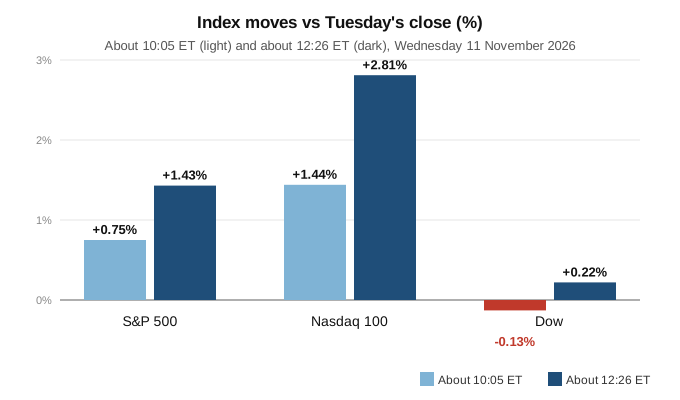
Wednesday 11 November, midday: Tuesday's rates scare is getting a very different answer today. As of about 12:26 ET, the S&P 500 is up 1.43% at roughly 7,628, the Nasdaq 100 is up 2.81% and the Dow Jones Industrial Average is up just 0.22%. The Nasdaq Composite is up 1.35% at 25,404.30. The rally has strengthened through the morning rather than fading: at about 10:05 ET the S&P 500 was up 0.75%, the Nasdaq 100 up 1.44% and the Dow down 0.13%. The S&P 500 moved above 7,600 during the session, edging back towards its record high.
The contrast with Tuesday is sharp. Yesterday all three indices closed lower — the Dow down 0.30% to 52,231.89, the S&P 500 down 0.38% to 7,520.93 and the Nasdaq Composite down 0.74% to 25,065.87 — after October inflation came in hotter than expected. Today the market is rallying on the same rates backdrop, with no help from the bond market: it is Veterans Day, so Treasuries are closed and the 10-year yield is frozen near 4.98%, where Tuesday left it after briefly topping 5%.
Figures in this article are intraday snapshots captured in New York between the open and about 12:35 ET. The session had not closed when this was written.
CoreWeave: the earnings beat that revived the AI trade
One company's results are doing most of the work today. CoreWeave (CRWV) is up 25.57% to $61.19 as of 12:35 ET, against Tuesday's close of $48.73, after opening at $55.97 and touching a high of $61.54. The AI cloud provider reported third-quarter revenue of $3.66 billion, up 168% year over year and ahead of the $3.55 billion analysts expected, and raised its full-year 2026 revenue guidance to $13.0 billion to $13.3 billion. It also reported a record revenue backlog of $132.5 billion, up 138% year over year, and said it expects to collect $9 billion in customer prepayments over the next three months.
Why it matters: CoreWeave is the stock investors have used as the test case for the AI spending debate — heavy debt, heavy capital spending, and doubts about whether the demand is real. The quarter answers the demand part in the clearest terms available: revenue up 168% and a backlog that keeps growing. The financing side is less settled, and the numbers show why the debate is not over: the company also reported a net loss of $709 million, up from $110 million a year earlier, and net interest expense of $846 million for the quarter. Management says it expects to turn profitable on an adjusted basis in the first half of 2028. For ordinary investors, the lesson is that a blowout revenue quarter and a clean balance sheet are two different things — today the market is rewarding the first and, for now, looking past the second.
Nvidia rebounds — and the whole chip sector goes with it
Nvidia (NVDA) is up 4.67% to $176.78 as of 12:35 ET, against Tuesday's close of $168.89, after opening at $172.80. The rebound follows two sessions in which the stock lost about $430 billion in market value, and it is still down about 14% since the start of November. The governance cloud has not lifted — the board's investigation into chief executive Jensen Huang continues, and Nvidia reports third-quarter results on 17 November — but today buyers are stepping back in.
What is different from Tuesday is that the buying is not confined to Nvidia. The Philadelphia Semiconductor Index is up about 3%, and the rally runs through the whole AI supply chain: AMD and Broadcom are each up more than 5%, Micron is up more than 5%, Intel is up 9.50% to $63.65, TSMC is up about 4% and ASML about 3%. Sandisk is up more than 11% to lead gainers in the S&P 500, with Seagate and Marvell up more than 6%, and Nebius up more than 12% ahead of its earnings on Thursday. OpenAI also reported quarterly revenue above $10 billion for the first time, another sign that demand for AI computing is still growing.
Why it matters: on Tuesday the market was asking whether the AI boom was running on borrowed money and borrowed time. Today's answer, from CoreWeave's order book and the breadth of the chip rally, is that the spending is real — at least for now. But the rally is narrow in one important sense: it is a technology rally, not a market-wide one, and the Dow's near-flat reading shows how little of it is reaching beyond the chip complex.
Intel keeps running
Intel (INTC) is the day's other big large-cap mover, up 9.50% to $63.65 as of 12:35 ET, against Tuesday's close of $58.13, after opening at $61.67 and touching a high of $64.06. The move extends Monday's rally, when JPMorgan upgraded the chipmaker to Neutral from Underweight with an $85 price target, and Intel disclosed that Tesla has agreed to use its forthcoming 14A manufacturing process — the first high-profile external customer for its most advanced planned node.
Why it matters: Intel is still down about 37% from its June peak — its 52-week high was $142.35 on 30 June — so this is a recovery inside a much larger decline, not a new high. But an analyst upgrade plus a marquee foundry customer is the clearest sign yet that investors are starting to price in the turnaround, and today's chip rally is carrying it further. Watch whether the shares can hold above $60 into the close.
The rates backdrop: a rally without its referee
The most unusual thing about today is what is missing. With the bond market closed for Veterans Day, there is no live Treasury trading to confirm or challenge the rally — the 10-year yield is frozen at about 4.98%, after jumping 11.9 basis points on Tuesday and briefly crossing 5%. The market is still pricing a December rate hike as a certainty, with an 86% to 87% chance of a 25-basis-point move according to the CME FedWatch tool, and Fed Governor Christopher Waller has opened the door to a possible 50-basis-point increase. The VIX, the market's fear gauge, has eased to about 18.5, down from Tuesday's close of 19.46.
Why it matters: yesterday's sell-off was a rates story, and the rates story has not gone away — it has simply gone quiet for a day. A stock rally built on strong earnings can hold while yields are frozen, but the test comes when the bond market reopens and traders have to price the December hike all over again. For ordinary investors, the point is that today's gains are real but conditional: the earnings are genuine, and so is the rate pressure sitting underneath them.
Oil firmer, and what to watch next
Oil is firmer after falling to a two-month low in the previous session: Brent crude is up 2.01% at $93.25 a barrel and West Texas Intermediate up 1.21% at $87.08. There are no Bureau of Labor Statistics releases scheduled today, and the MBA mortgage applications index was due at 07:00 ET.
The rest of the week still holds the set pieces that will decide whether this rebound lasts. On Thursday, weekly jobless claims arrive at 08:30 ET, and Cisco and Applied Materials report earnings after the close — Applied Materials is the next check on chip-equipment demand after today's rally. October's Producer Price Index follows on Friday at 08:30 ET. And the date that matters most for the AI trade is Tuesday 17 November, when Nvidia reports.
For ordinary investors, the midday message is a useful one to hold on to: a single earnings report can turn a market around in a morning, but it does not settle the argument. The AI spending boom looks real in CoreWeave's numbers, and the chip sector agrees today — yet the December rate hike is still priced as a certainty, yields are still near 5%, and the bond market has not had its say. The rebound is genuine; whether it is durable is a question for the rest of the week.
For education only. Not financial advice.
Sources
- StockSetups: Stock Market Today, Nov 11 — S&P 500 +1.4%, Nasdaq 100 +2.8%, Dow +0.2%
- Barchart: Stocks Climb as AI Demand Worries Ease on CoreWeave Earnings
- Finnhub: CRWV quote, 12:35 ET
- Finnhub: NVDA quote, 12:35 ET
- Finnhub: INTC quote, 12:35 ET
- TipRanks: Stock Market Today, Nov. 11 — U.S. Tech Stocks Rise After CoreWeave's Strong Results
- Binance / Sina Finance: CoreWeave Results Lift AI Trading Sentiment as Chip Stocks Rally
- CNBC TV18 via TradingView: US Markets — Wall Street traded higher on Wednesday
- AI World Today: AI Stocks Rebound After Sharp Sell-Off as Nvidia, ASML and Chipmakers Recover
- Zacks: Stock Market News for Nov 11, 2026
- OrbitLens 100: Stocks to watch today — futures rebound as CoreWeave calms AI fears